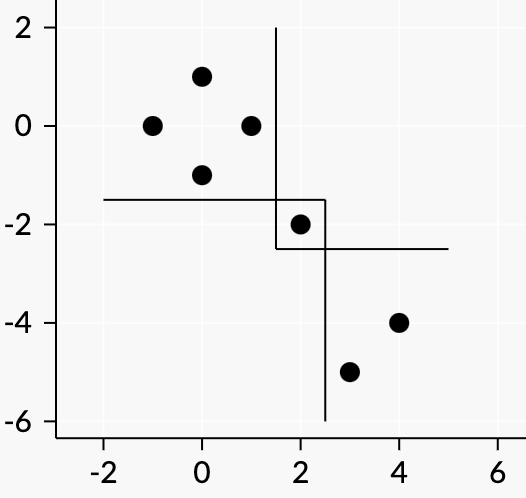
Construct an undirected graph where each vertex represents a moo particle and there exists an edge between two moo particles if they can interact. An interaction corresponds to removing a vertex with at least one adjacent edge.
Within each connected component, at least one particle must remain. Conversely, we can show that this is always attainable. Consider a spanning forest of the graph; just keep removing a particle that is a leaf in this forest.
It remains to show how to compute the number of connected components in faster than $O(N^2)$. Sort the moo particles in increasing order of $x$ and then $y$. Initially, suppose that each particle is its own connected component. Then while there exist two connected components that are adjacent in the order such that the minimum $y$-coordinate in the left component is at most the maximum $y$-coordinate of the right coordinate, combine them together.
For the following input (a combination of the two samples), the answer is 3.
7
1 0
0 1
-1 0
0 -1
3 -5
4 -4
2 -2
After this is done, the $i$-th moo particle in the sorted order is not in the same connected component as the $i+1$-st if and only if $\min(y_1,y_2,\ldots,y_i)>\max(y_{i+1},y_{i+2},\ldots,y_N)$ (which automatically implies that $\max(x_1,x_2,\ldots,x_i)<\min(x_{i+1},x_{i+2},\ldots,x_N)$). So after sorting we only need $O(N)$ additional time to compute the answer.
Dhruv Rohatgi's code:
#include <iostream>
#include <algorithm>
using namespace std;
#define MAXN 100000

int N;
int x[MAXN], y[MAXN];
int cid[MAXN];
int minl[MAXN];
int maxr[MAXN];

bool cmp(int a,int b)
{
	if(x[a]==x[b]) return y[a]<y[b];
	return x[a]<x[b];
}


int main()
{
	freopen("moop.in","r",stdin);
	freopen("moop.out","w",stdout);
	cin >> N;
	for(int i=0;i<N;i++)
	{
		cin >> x[i] >> y[i];
		cid[i] = i;
	}
	sort(cid,cid+N,cmp);
	minl[0] = y[cid[0]];
	for(int i=1;i<N;i++)
		minl[i] = min(minl[i-1], y[cid[i]]);
	maxr[N-1] = y[cid[N-1]];
	for(int i=N-2;i>=0;i--)
		maxr[i] = max(maxr[i+1], y[cid[i]]);
	int ans = 1;
	for(int i=0;i<N-1;i++)
		if(minl[i] > maxr[i+1])
			ans++;
	cout << ans << '\n';
}
Related (but harder) problems: